Cheshire’s Debbie Dixon has been working alongside the charity Cardiac Risk in the Young (CRY) for the past decade as part of her mission to prevent sudden cardiac death in young people
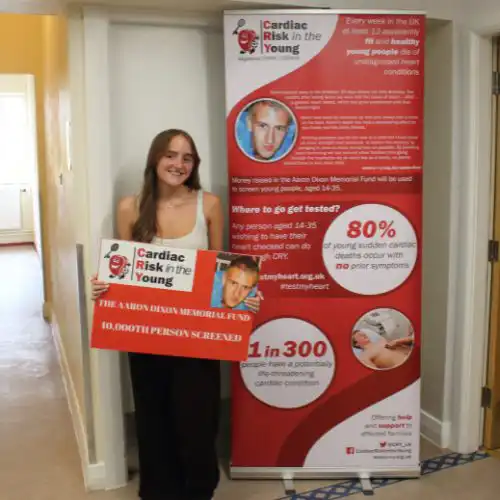
Saturday 5 July saw the 10,000th young person screened by the expert team at Cardiac Risk in the Young CRY) – thanks to funds raised in memory of local Cheshire man, Aaron Dixon, who tragically died in September 2011 from a previously undiagnosed heart condition. He was just 23 years old.
Since Aaron’s death, his mum Debbie has devotedly raised funds for CRY – driven by a desire to ensure that no other parent should experience the same devastating grief. Supported by her husband Gary, daughter Hollie, hordes of Aaron’s friends and their wider community, Debbie has maintained her mission of testing the hearts of young people across the UK (although always with a firm focus on the North West).
Debbie, from Tarporley recalls that on the day Aaron died; “Everything seemed normal. He had been out the night before with his sister Hollie and their friends and was just up in his bedroom.”
Later, Debbie sent her husband Gary upstairs to tell Aaron that his dinner was ready. Hearing Gary scream, Debbie rushed upstairs to find him doing CPR. Paramedics arrived, but it was too late. A coroner later explained that Aaron, a keen footballer and gym-goer, had an undetected genetic heart defect called arrhythmogenic right ventricular cardiomyopathy (ARVC) that can cause cardiac arrest, if undetected and untreated.
Committed to preventing these tragedies, Debbie has worked tirelessly over the past 10 years to bring screening services to young people – as well as joining CRY’s continued campaign that one day hopes to see the implementation of a national screening programme (similar to those ‘rolled out’ across the UK to ensure the early detection of cancer) funded by the Government and not bereaved families.
And, reflecting this incredible journey, last weekend Saturday 5th July, the 10,000th heart screening carried by the Aaron Dixon Memorial Fund and CRY, took place at an event held in Debbie’s hometown of Tarporley at the War Memorial Hospital.
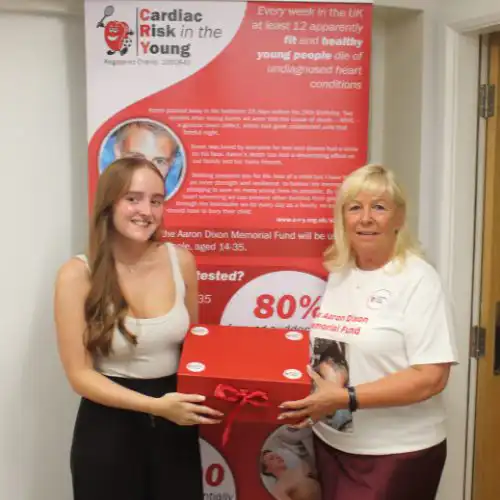
To date, funds raised by Debbie and her community of supporters has led to 425 young people being identified with heart anomalies which have required referrals for further investigations and potentially lifesaving treatments.
Debbie adds; “Every screening we have held has resulted in at least one, if not more, person, being referred for further, in-depth investigations, following a suspected abnormality being picked up by an ECG. Sadly, we know that every week in the UK, 12 young people aged 35 and under die due to an undiagnosed heart condition and so I’ve always believed that by supporting CRY, our fundraising and awareness work is going some way to preventing other families from the same suffering and honouring my son’s memory in a meaningful way.”
Debbie has also successfully secured funding from The JD Foundation who became proud partners of the Aaron Dixon Memorial Fund in 2016 – a collaboration which has seen hundreds of athletes having their hearts tested, across a variety of sports.
And whilst Debbie has raised over £780,000, funding 115 days of cardiac screening, to date – her eyes are still firmly set on hitting the million-pound mark one day soon!
But Debbie says; “It’s quite simple really, I just want all young people to be screened. I want to keep Aaron’s memory alive, and I don’t want anyone else to lose a child like we have. Yes, I’ve dedicated my life to this mission, but I’ve got my family and Aaron’s large circle of friends who are behind me every step of the way and who play a big part in Aaron’s Memorial Fund. They are my link to my precious son, and I couldn’t do this without them all.”
CRY now screens around 30,000 young people (aged 14-35) every year across the UK – and since the charity was first launched in 1995 has tested over 330,000 young hearts.
One in every 300 people of those tested by CRY will be identified with a potentially life- threatening condition. And, in 80% of cases of young sudden death, there will have been no warning signs or symptoms which is why CRY believes proactive and preventative screening is so vitally important.
Most CRY’s screenings take place in community settings (e.g. schools, colleges, church halls and sports clubs) across the UK. Twice a month, around 100 young people (aged 14-35) are also screened at CRY’s National Screening Centre, now based in Leatherhead, Surrey.
The majority of CRY’s screenings are funded by families (such as Debbie’s) who have been affected by a young sudden cardiac death, so there is no charge to the individual when CRY’s mobile cardiac screening service comes to a local venue.
Many of the young people who are identified through community screenings with potential abnormalities will be referred back to CRY’s Consultant Cardiologist, Professor Sanjay Sharma and his expert team at St George’s Hospital, London for further investigations or to a specialist centre for Inherited Cardiac Conditions (ICC) in their local areas.
CRY’s CEO, Dr Steven Cox, adds; “Debbie’s dedication over the past decade has been nothing short of extraordinary. Reaching 10,000 young people screened in memory of Aaron is a deeply moving milestone — not just for Debbie and her family, but for all of us at CRY.
“Every life potentially saved through these screenings is part of Aaron’s lasting legacy, and we are incredibly grateful for Debbie’s commitment to the prevention of young sudden cardiac deaths.”